
Understand yourself: Coping and self-efficacy
Example hero paragraph text.

- Learn about how your beliefs about what you can achieve are related to how you cope.
- Learn about how you deal personally with difficulties in graduate school.
“I have learned to deal with my daily stress with a nice bath in the evenings when I get home. This seems to be the best way to unwind and take my mind off things.”
“Each time I join a new team or start a new project, I feel extremely unsure of my abilities. I lose a lot of sleep over these transitions.”
“A surplus of effort could overcome a deficit of confidence.” – Sonia Sotomayor
It is easy to feel out of control with the incessant demands of graduate school. Paying attention to the way you tend to cope with these demands is important, as is assessing whether or not these coping strategies are working for you. If the way you deal with obstacles and difficulties doesn’t improve the situations or makes them even worse, then this module is for you. You can strengthen your coping strategies so you have more flexible and appropriate ways to manage graduate school.
Coping is any effort you make to alleviate stress, control your environment, or overcome something you find threatening. Coping might mean that you do something to alter the source of the stressor or by making efforts to diminish negative emotions about the situation. Coping is situational but can also reflect your patterns of behavior. Additional factors, including culture and gender, are also known to be associated with different coping styles. (Heppner et al., 2006; Tamris et al., 2002).
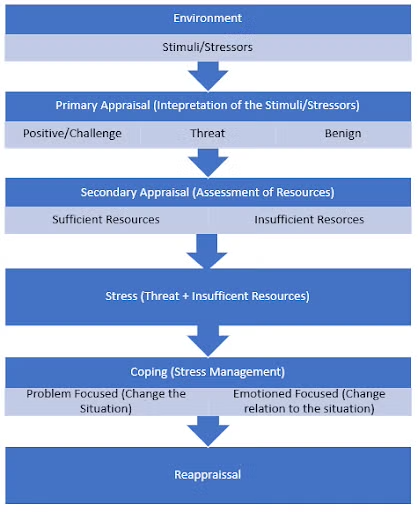
According to the transactional model of stress and coping (Lazarus & Folkman, 1984), when a potential stressor (e.g., failing a qualifying exam) emerges, the individual first assesses the situation as threatening, positively challenging, or benign (primary appraisal) In primary appraisals, the individual evaluates the personal relevance of the situation – whether it threatens one’s goals, resources, or values. The person then evaluates what coping resources are available for meeting stressor demands (secondary appraisal). The emotional experience of stress occurs when the coping resources available are not sufficient to meet the demands.
The transactional theory groups coping behaviors by their functions: problem-focused coping and emotion-focused coping (Lazarus & Folkman, 1984). Problem-focused coping entails strategies to actively deal with the stressor itself. Emotion-focused coping refers to efforts to deal with one’s emotional responses to the stressor.
Reflection: Your Ways of Coping
When you are encountering stressors in your academic or personal life, are there some coping strategies from the following examples that you use more than others (Carver, Scheier, & Weintraub, 1989)?
Problem-focused Coping (Directed at changing the situation): Do You …
- Plan what you will do?
- Seek tangible assistance?
- Put less important things on hold?
- Actively approach the problem?
Emotion-focused Coping (Directed at regulating your stress-related emotions): Do You …
- Seek out emotional support from others?
- Assign a more positive meaning to the problem?
- Take a day to de-stress and recharge?
- Avoid thinking about the situation?
- Accept the situation?
Self-test
A) Tran needs someone to proofread her paper. She asks her advisor about what resources are available for ongoing assistance with her writing. He refers her to the writing resource center on campus.
B) Mona has been stressed all week because the date to submit a proposal to an upcoming conference is only three days away and no one in the lab group has taken the initiative to get it finished. She figures it’s a group process and if no one wants to help finish it, she’ll just let the deadline pass without completing the proposal.
C) Rebecca and Armando are lab partners. However, she does the majority of work on their projects, which causes her a lot of stress. Instead of addressing this with Armando, she continues to hope that he just figures out there is a defined inequity in their work together.
D) Petra is 12 weeks pregnant. She was supposed to go to Morocco to do fieldwork for the next six months. Given that she would have to deliver the baby abroad, she decides to accept a field placement in New Mexico and go to Morocco the year after.
Which of the above scenarios represent problem-focused or emotion-focused coping?
- A. Answers A & D
- B. Answer A
- C. Answer B
- D. Answer C
- E. Answer D
A is the correct answer,
Answer: The correct answer is both A and D, Tran and Petra cope with problem-focused action. In B and C, Mona and Rebecca avoid their problems.
If you find that you tend to avoid difficult situations and certain types of problems, ask yourself why. Maybe you think the solution to the problem will be awkward or uncomfortable to carry out. Perhaps the solution is in conflict with your values. Maybe you have too many other more important problems to deal with at this time.
A lot of avoidance-style coping behavior is likely due to your beliefs about whether or not you are in control of a desired outcome. Unfortunately, avoiding the problem probably won’t make it go away. In fact, it could make the situation worse, which might make your tendency to avoid this type of problem even stronger. Stop the cycle. Ask yourself what needs to change so the solution is in your hands.
It may be helpful to approach the problem in a different way than you did before, like Tran did in the prior example. Tran doesn’t usually ask for help when it comes to school. She prefers to get things done on her own. This time, she asked her cohort for their advice on getting started, looked at online resources about writing a dissertation, and scheduled ongoing meetings with her advisor. She was surprised by how helpful everyone was to her and by how much her relationship with her advisor grew during this process. Sometimes you do not realize the personal and outside resources available to help you cope effectively with difficult situations.
Your belief about your ability to perform a particular behavior successfully is known as self-efficacy (Bandura, 1997). Think of self-efficacy as a domain-specific type of self-confidence. For example, whereas you may have general confidence in your abilities to be successful in leading a group project in biology, you may nevertheless be convinced that passing your physics class is outside of your reach.
Along with self-efficacy, your persistence is related to your beliefs about whether your actions will have positive results (outcome expectations). Career self-efficacy (i.e., your beliefs about your abilities and potential in your prospective career area) is associated with your choosing it, how much you like it, and your persistence in it. (Honicke & Broadbent, 2016; Lent, Brown & Hackett, 1994; Lent, Miller et al., 2016). Women often have lower self-efficacy than men in traditionally male-dominated occupations and are thus less likely to pursue these career paths. (Betz & Hackett; Byars & Hackett; Dortch, 2016; Hackett; Hackett & Byars, 1996; Marshman et al., 2018; Zeldin & Pajares, 2000, 2006). Self-efficacy is subjective; it is not necessarily an accurate appraisal of your actual abilities.
Your self-efficacy can originate from four types of sources (Bandura, 1997). Some strengthen your self-efficacy in a domain, others weaken it. Evidence shows that for women, vicarious experiences like role modeling and social persuasion are the primary sources of self-efficacy compared to past performance for men (Zeldin, Britner & Pajares, 2008).
Sources of Efficacy
Past accomplishments:
A record of good grades
Awards and honors
Being a published author
Your vicarious experiences:
What you observe other women experiencing
What your parents/family/friends have gone through
Faculty women role models
What others tell you:
Messages you get from the media that influence your perceptions
What people tell you, such as “You would make a terrific teacher!” or “You should consider going into research.”
“Women aren’t good at this”
Recognition of your physical and emotional states:
Excitement
Heart racing, sweaty palms
Anxiety
Calm
Good mood
Self-test
Which of the following illustrate Self-Efficacy?
- A. Liza always comes across as a confident person in class.
- B. Danielle is outspoken and not afraid of speaking her mind.
- C. Hiroko is confident in her ability to run the analysis correctly.
- D. Shalayna feels really good about her performance on the test.
B is the correct answer,
The best answer is C. While answers A and B may suggest self-confidence or even self-esteem, they are based on others’ perceptions, and not Liza’s and Danielle’s own appraisals of their abilities within specific domains or areas. Similarly, answer D is more about Shalayna’s mood state after her test. Answer C shows Hiroko’s belief in her own ability to run the analysis—her self-efficacy in that domain.
Bandura’s theory of self-efficacy and its derivative of Social-Cognitive Career Theory (Lent, Brown & Hackett, 1994) have spawned decades of research showing the important consequences for pursuing and succeeding in STEM careers.
Confidence in your coping ability and how you cope in situations impact your stress level, which in turn affects your psychological and physical well-being.
Self-efficacy is associated with your academic choices and career aspirations.
Self-efficacy predicts how you will cope with a problem. This includes whether you will use helpful coping strategies and how much effort you will put into solving it.
The extent to which you resolve difficulties that hinder your progress will influence your academic and career performance, persistence, and achievements.
Self-efficacy is associated with well-being.
Coping efficacy is a specific aspect of self-efficacy. It is defined as your belief about your ability to manage or negotiate obstacles or challenges (Lent, Brown & Hackett, 1994). How you cope with different challenges actually has more to do with your coping efficacy than the type of challenge itself. Put differently, two people facing the same dilemma will have very different ways of approaching it, according to each individual’s belief about her ability to solve that type of problem.
Reflections: Rating Your Coping Efficacy
On a scale of 1 to 5, how would you rate your belief in your ability to cope with the following challenges? (1 = Impossible for me; 5 = Fully confident that I can cope with it)
- Your research project loses funding.
- Your advisor tells you that if you decide to get married or have children during graduate school, he will no longer employ you in his lab.
- Your advisor lets you know that she is moving out-of-state to another university.
- Your labmates leave you out of major decisions regarding your lab work.
- Your dissertation proposal was criticized heavily by your advisor, and you are back to the drawing board.
- Your partner got a job at another university, but you have a year left in your program.
If you rated your ability to overcome these potential roadblocks as high, you are likely to deal with such challenges in a proactive manner were they to occur.
If your ratings were relatively low, you may lack confidence in your ability to handle the challenges in your life. Stress is strongly and inversely associated with coping efficacy. It is important to embrace the perception that problems over which you have control are solvable and that you can learn the skills to manage whatever obstacles you encounter. This doesn’t mean fixing each problem. Rather, coping might involve minimizing its negative effects or coming to a place of acceptance about a negative outcome. In some instances, it may mean reporting situations to responsible authorities.
There are many ways of coping with a given challenge. Bolstering your repertoire of coping skills is beneficial for overcoming the challenges of graduate school. Your subjective beliefs about whether or not you can overcome challenges will play a part in which coping strategies you employ.
Bandura, A. (1977). Self-efficacy: Toward a unifying theory of behavioral change. Psychological Review. 84(2), 191-215. https://doi.org/10.1037/0033-295X.84.2.191
Betz, N. E., & Hackett, G. (1981). The relationship of career-related self-efficacy expectations to perceived career options in college women and men. Journal of counseling psychology, 28(5), 399. https://doi.org/10.1037/0022-0167.28.5.399
Byars, A. M., & Hackett, G. (1998). Applications of social cognitive theory to the career development of women of color. Applied and Preventive Psychology, 7(4), 255-267.https://doi.org/10.1016/S0962-1849(98)80029-2
Carver, C. S., Scheier, M. F., & Weintraub, J. K. (1989). Assessing coping strategies: A theoretically based approach. Journal of Personality and Social Psychology, 56, 267-283. https://doi.org/10.1037/0022-3514.56.2.267
Crum, A. J., Akinola, M., Martin, A., & Fath, S. (2017). The role of stress mindset in shaping cognitive, emotional, and physiological responses to challenging and threatening stress. Anxiety, stress, & coping, 30(4), 379-395.https://doi.org/10.1080/10615806.2016.1275585
Dortch, D. (2016). The strength from within: A phenomenological study examining the academic self-efficacy of African American women in doctoral studies. The Journal of Negro Education, 85(3), 350-364.https://doi.org/10.7709/jnegroeducation.85.3.0350
Hackett, G. (1985). Role of mathematics self-efficacy in the choice of math-related majors of college women and men: A path analysis. Journal of counseling psychology, 32(1), 47. http://dx.doi.org/10.1037/0022-0167.32.1.47
Heppner, P. P., Heppner, M. J., Lee, D.-g., Wang, Y.-W., Park, H.-j., & Wang, L.-f. (2006). Development and validation of a collectivist coping styles inventory. Journal of Counseling Psychology, 53(1), 107–125. https://doi.org/10.1037/0022-0167.53.1.107
Honicke, T., & Broadbent, J. (2016). The Relation of Academic Self-Efficacy to University Student Academic Performance: A Systematic Review. Educational Research Review, 17, 63-84. http://dx.doi.org/10.1016/j.edurev.2015.11.002
Lazarus, R. S., & Folkman, S. (1996). Stress, appraisal, and coping. New York: Springer.
Lent, R. W., Brown, S. D., & Hackett, G. (1994). Toward a unifying social cognitive theory of career and academic interest, choice, and performance. Journal of Vocational Behavior, 45, 79-122.https://dx.doi.org/10.1006/jvbe.1994.1027
Lent, R. W., Miller, M. J., Smith, P. E., Watford, B. A., Lim, R. H., & Hui, K. (2016). Social cognitive predictors of academic persistence and performance in engineering: Applicability across gender and race/ethnicity. Journal of Vocational Behavior, 94, 79-88.https://doi.org/10.1016/j.jvb.2016.02.012
Marshman, E. M., Kalender, Z. Y., Nokes-Malach, T., Schunn, C., & Singh, C. (2018). Female students with A’s have similar physics self-efficacy as male students with C’s in introductory courses: A cause for alarm?. Physical review physics education research, 14(2), 020123. http://dx.doi.org/10.1103/PhysRevPhysEducRes.14.020123
Rice, A., Garrison, Y. L., & Liu, W. M. (2020). Spending as Social and Affective Coping (SSAC): Measure Development and Initial Validation. The Counseling Psychologist, 48(1), 78-105.https://doi.org/10.1177/0011000019878848
Stanton, A. L., Kirk, S. B., Cameron, C. L., & Danoff-Burg, S. (2000). Coping through emotional approach: scale construction and validation. Journal of personality and social psychology, 78(6), 1150. https://doi.org/10.1037/0022-3514.78.6.1150
Tamres, L. K., Janicki, D., & Helgeson, V. S. (2002). Sex differences in coping behavior: A meta-analytic review and an examination of relative coping. Personality and Social Psychology Review, 6, 2-30.https://dx.doi.org/10.1207/S15327957PSPR0601_1
Wilson, D., Bates, R., Scott, E. P., Painter, S. M., & Shaffer, J. (2015). Differences in self-efficacy among women and minorities in STEM. Journal of Women and Minorities in Science and Engineering, 21(1). https://doi/org/10.1615/JWomenMinorScienEng.2014005111
Zeldin, A. L., Britner, S. L., & Pajares, F. (2008). A comparative study of the self‐efficacy beliefs of successful men and women in mathematics, science, and technology careers. Journal of Research in Science Teaching, 45(9), 1036-1058. https://doi.org/10.1002/tea.20195
Zeldin, A.L., & Pajares, F. (2000). Against the odds: Self-efficacy beliefs of women in mathematical, scientific, and technological careers. American Educational Research Journal, 37, 215–246 https://doi.org/10.3102/00028312037001215
Becoming an Independent Voice as a Young Faculty Member
The process of establishing yourself in the same department as your spouse
Hidden Differences in Academic Culture
Adjusting physical appearance to fit in with peers
Is Being Socially Compatible Necessary?
Reminder that it is not necessary to feel comfortable socially to do good science
Lack of Women Role Models
The importance of sharing stories of sexual harassment with others and realizing that you are not alone
It’s the Little Things that Annoy You (Part 1)
The importance of picking your battles to avoid unfair labeling
Help and Support from Other Administrators
How to seek support from administrators outside the department when dealing with departmental sexism
The Upside to Children Prior to a Tenure Track Position
Explains the choice to have children in graduate school
Being Comfortable as a Woman Among Men
Emphasizes positive peer relationships within her cohort
Stress from Conflict in a Dating Relationship
Elaborates on a dating situation
Dealing with Assumptions and Accusations (Short Version)
Being accused of cheating and regrets about not being more assertive