
Understand yourself: Emotional styles
Example hero paragraph text.

- Learn to catch yourself responding emotionally.
- Learn how your emotional patterns influence how you cope with setbacks and conflicts.
“My advisor made some critical comments about my dissertation the other day. I was so upset I could not focus the rest of the day.”
“I had the worst day at the lab. Everything seemed to be going wrong. I blew up at my partner when I got home and started a huge fight.”
How do you react to criticism from an advisor? Are you likely to become hurt and ruminate over the feedback, like the student quoted above? Do you often say or do something in the heat of the moment only to regret your behavior later? We all let our emotions get the best of us from time to time. We also vary in our typical emotional reactions to different situations.
“Emotional styles” refers to individual patterns of responding emotionally to life stressors. For example, when it comes to dealing with negative feelings, do you:
Try to ignore them by distancing yourself?
Become engulfed by your emotions, allowing yourself to spiral out of control?
Accept negative emotions but do nothing to change them?
Acknowledge your negative emotions and their source and act to change things for the better?
Emotional Intelligence (EI) is a way of understanding your strengths and areas to develop in the realm of emotions (Goleman, 1995; Salovey & Mayer, 1990). It has several components, each of which contributes to effective interpersonal communication and relationships.
EI refers to your abilities to:
- Notice what you are feeling and tell the difference between your emotions;
- Express (appropriately) how you are feeling;
- Understand the source of your emotions;
- Notice and understand emotions in others;
- Control your emotional reaction;
- Use this emotional knowledge and control to help navigate your life.
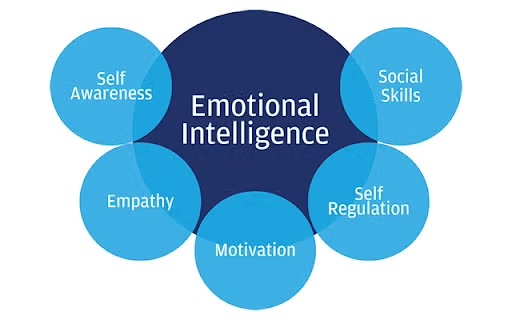
Your abilities to perceive, integrate, understand, and manage your emotions are related to career success (Barchard, 2003), social support (Fredrickson, 2007), and physical health (Barchard, 2003). EI is also associated with your ability to manage stress (Goleman, 1996) and to exert influence over others (Gross, 2015).
Assessing your Emotional Intelligence skills can help you understand and adapt the way you apply emotional regulation, empathy, and other skills to your behavior for favorable outcomes.
Emotional self-awareness, the first element of EI, is the basis from which other aspects of EI are developed. This is the area that most people associate with emotional accessibility. The steps you can take to improve your emotional awareness include the following:
- Know the feeling is present. Pay attention to your personal cues.
Why am I getting all sweaty? Did someone just turn up the heat in here?
- Acknowledge the feeling. Recognize that your body and/or mind is telling you something important.
OK, I don’t think it’s the thermostat. I’m having a reaction to something.
- Identify the feeling. Label it.
I am breaking out in a sweat because I’m really nervous.
- Accept the feeling. Realize this feeling has a purpose. It’s not bad; rather, it’s a messenger.
I feel nervous, but that’s OK, I’ll take five deep breaths and relax and then think about why I’m feeling this way.
- Reflect on the feeling. Take a moment to understand why you are feeling the way you do.
I’m nervous because I’m dreading telling my labmates that the bacteria samples are spoiled.
- Forecast the feeling. Project the future with a positive outlook.
It’ll be OK, and I don’t have to be nervous about breaking the news because it wasn’t anyone’s fault. We’ll just have to request that the lab send new ones.
Test your beliefs on Emotional Awareness. Answer True or False to the following:
- Being emotionally aware takes a lot of time and energy. ___
- Emotional awareness is connected to feeling happier and being more successful in your chosen endeavors. ___
- Being emotionally aware can foster better mental and physical health. ___
- Emotional awareness is not connected to academic success because it deals primarily with feelings. ___
- If I am more emotionally aware, I will also be more sensitive and attentive to the feelings of others. ___
Out of these 5, only #1 and #4 are FALSE.
If you believe in the benefits of emotional awareness, you will be more likely to commit to strengthening this skill. You can practice emotional awareness in real time or as an emotion is creeping up. Once you get used to it, it becomes natural.
With awareness of negative emotions like anger or disgust, you can catch yourself before saying or doing something that may come back to bite you later. With self-focused emotions like guilt or shame, you will also want to be careful about how, when, and with whom you share them. Emotional awareness starts with recognition and then taking a moment to stop and reflect.
You can also become more aware of positive emotions. We are often self-critical and do not give enough attention to positive feelings such as pride, happiness, and satisfaction.
Paying attention to, savoring, displaying, and celebrating positive emotions are all linked to positive emotional, behavioral, and physiological outcomes (Diener, Thaper & Tay, 2020). It is important to take time to feel these emotions as you continue to build resilience and strength for coping with adversity.
Identify the situation, your feelings before the situation, and ultimately the behaviors you engaged in to reach the current positive emotions you are experiencing. Next time you are faced with a difficult situation, remember the positive emotions you obtained from following through despite the challenges.
Use the recollection of these positive emotions as a means to motivate yourself and continue to strengthen self-efficacy (See Coping and Self-Efficacy for more).
Your thinking habits play an important role in how you respond emotionally and behaviorally. How you view a problem, especially whether you think you have the resources to deal with it, impacts how you feel about it and what you choose to do about it (Folkman & Lazarus, 1988). (See How You Think).
Following are examples of two different thought-and-feeling sequences for the same situation:
Example 1 – Amber:
Situation/Stressor – I received negative feedback on my dissertation proposal. Most of it will need to be changed.
Thought – Aaack, I’ll never finish this degree.
Emotions – Frustrated, worried
Coping Behavior Emotion-focused Coping: Procrastination, problem avoidance.
Outcome – Misses the deadline for changes to the dissertation. Delayed on graduation.
Example 2 – Martina:
Situation/Stressor – I received negative feedback on my dissertation proposal. Most of it will need to be changed.
Thought – It’s hard feedback, but I’ll learn from it. I’m going to use it as a way to prove myself.
Emotions – Confident, excited
Coping Behavior – Problem-focused Coping:
Outcome – Meets regularly with dissertation committee to adapt dissertation in a timely manner.
Strengthens collaboration with dissertation committee. Successfully defends dissertation.
Emotions are a central element in how things work out. As illustrated above, emotions follow how you think about a potential stressor. However, emotions also follow from how you choose to cope with a situation (Folkman & Lazarus, 1988).
In the example above, Amber procrastinates and misses the deadline. She ends up disappointed and angry. Martina deals with the problem head-on, finishes the dissertation, and is proud and even more confident than before. See Coping and Self-efficacy for more on emotion-focused and problem-focused coping.
A different way to understand emotional styles is with the theories around emotional regulation. Emotional regulation is more directly related to Emotional Intelligence, in that it refers to how you influence which emotions you have, when you have them, and how you experience and express them (Gross, 2015).
In regulating emotions, you are purposely trying to change your emotions. You want to either decrease negative emotions or increase positive emotions to feel better or change your expression for instrumental reasons (Tamir, 2016).
For example, you may want to actually attempt to feel happier after a disappointment or to look happier so you do not appear sullen at a social event with your friends. Likewise, you may work to calm your anger at a partner to maintain your relationship or hold on to your irritation as you enter a negotiation about your workload.
According to the process model of emotional regulation (Gross 1998), there are five regulatory processes you can use to increase or decrease your experience or expression of emotion. They are differentiated by time.
Antecedent-focused processes, which precede a full emotional response:
- selecting or avoiding the situation that provokes your emotion
- modifying the situation
- directing your attention toward or away from the situation
- changing your interpretation of the situation
Response-focused processes, which occur after the emotional response arises:
- suppressing the expression of the emotion
You might be wondering which of the strategies works best. The answer is “it depends.”
What is effective depends on your emotional goals and your outcome goals, the particular emotion, the context, the cultural norms, and the short-term versus the longer term (Aldao & Nolen-Hoeksma, 2012; Newman & Nezlik, 2021; Webb, Miles, & Sheeran, 2012; Wei et al., 2013).
In general, however, cognitive-reappraisal strategies (thinking a different way about the situation or emotion or accepting it) and suppressing the expression of the emotion are most associated with emotional intelligence and well-being (Megías-Robles et al, 2019; Newman & Nezlik, 2021; Vishkin, et al. 2020; Webb, Miles & Sheeran, 2012).
Whether you are refraining from snapping at your friend, pretending not to be interested in your secret crush, not sharing with a sick relative your excitement about an award you received, or trying not to look bored during a dull lecture, you are demonstrating emotional intelligence by controlling your emotional reaction.
To control your negative emotional reactions, you can:
Write in a journal.
Gain a new perspective on the thought behind your emotion.
Take a short walk before deciding how to react.
Breathe deeply before reacting.
Which of these strategies do you think work best in regulating your emotions?
- Train yourself to pause before expressing negative emotions.
- Emphasize that you have the right to feel whatever feelings you are experiencing.
- Re-think your attitudes about your circumstances.
- Reappraise the situation and remember your resources.
- Rely on others to help you with your feelings.
- Recognize and identify emotions that may be out of line with the circumstances
- Choose the right time and place to express your emotion.
- Ignore emotions that distract you from your work.
- Cultivate mindfulness.
Though all of these are possible ways to regulate your emotions, numbers 1, 3, 4, 6, 7, and 9 are the best strategies that provide the most benefit to you. They place the power to control your emotions in YOUR hands.
Numbers 2, 5, and 8 are popular tactics, but they are referred to as avoidant coping. They represent ways to avoid feeling important emotions that guide our understanding of our reactions and choices
Thinking habits, temperament, culture, and how we regulate our emotions contribute to our emotional styles. Like our personalities, our emotional styles vary, but we do have some control over our emotional reactions.
We can’t choose the emotions we feel, but we can choose the ways in which we respond, through emotional awareness. Learning to better regulate our emotions and subsequent actions can help to calm difficult situations and improve relationships.
You have often heard to count to 10 or take a walk when you are upset or frustrated. Indeed, simply deciding not to react when you are upset may still be one of the best ways to avoid a regrettable emotional reaction.
Aldao, A., & Nolen-Hoeksema, S. (2012). The influence of context on the implementation of adaptive emotion regulation strategies. Behaviour Research and Therapy, 50(7-8), 493-501. https://doi.org/10.1016/j.brat.2012.04.004
Barchard, K. A. (2003). Does emotional intelligence assist in the prediction of academic success?. Educational and Psychological Measurement, 63(5), 840-858. https://doi.org/10.1177/0013164403251333
Boyatzis, R., Rochford, K., & Cavanagh, K. V. (2017). Emotional intelligence competencies in engineer’s effectiveness and engagement. Career Development International, 22(1), 70-86. https://doi.org/10.1108/cdi-08-2016-0136
Diener, E., Thapa, S., & Tay, L. (2020). Positive emotions at work. Annual Review of Organizational Psychology and Organizational Behavior, 7, 451-477. https://doi.org/10.1146/annurev-orgpsych-012119-044908
Fernandez-Berrocal, P., Extremera, N., Lopes, P. N., & Ruiz-Aranda, D. (2014). When to cooperate and when to compete: Emotional intelligence in interpersonal decision making. Journal of Research in Personality, 49, 21–24. https://doi.org/10.1016/j.jrp.2013.12.005
Folkman, S., & Lazarus, R. S. (1988). Coping as a mediator of emotion. Journal of Personality and Social Psychology, 54(3), 466. https://doi.org/10.1037/0022-3514.54.3.466
Fredrickson, B. L. (2007). Regulation of positive emotions: Emotion regulation strategies that promote resilience. Journal of Happiness Studies, 8(3), 311-333. https://doi.org/10.1007/s10902-006-9015-4
Goleman, D. (1995). Emotional Intelligence: Why it can matter more than IQ. New York: Bantam Dell.
Gross, J. J. (2015). Emotion regulation: Current status and future prospects. Psychological Inquiry, 26(1), 1-26. https://doi.org/10.1080/1047840X.2014.940781
Mankus, A. M., Boden, M. T., & Thompson, R. J. (2016). Sources of variation in emotional awareness: Age, gender, and socioeconomic status. Personality and Individual Differences, 89, 28-33. https://doi.org/10.1016/j.paid.2015.09.043
Mayer, J., & Salovey, P. (1997). What is emotional intelligence? In P. Salovey & D. J. Sluyter (Eds.), Emotional development and emotional intelligence (pp. 3-31). New York: Basic Books.
Mayer, J. D., Caruso, D. R., & Salovey, P. (2016). The ability model of emotional intelligence: Principles and updates. Emotion Review, 8, 290–300. https://doi.org/10.1177/1754073916639667
Megías-Robles, A., Gutiérrez-Cobo, M. J., Gómez-Leal, R., Cabello, R., Gross, J. J., & Fernández-Berrocal, P. (2019). Emotionally intelligent people reappraise rather than suppress their emotions. PloS one, 14(8), e0220688. https://doi.org/10.1371/journal.pone.0220688
O’Meara, K., Knudsen, K., & Jones, J. (2013). The role of emotional competencies in faculty-doctoral student relationships. The Review of Higher Education, 36(3), 315-347. https://doi.org/10.1353/rhe.2013.0021
Newman, D. B., & Nezlek, J. B. (2021). The influence of daily events on emotion regulation and well-being in daily life. Personality and Social Psychology Bulletin. https://doi.org/10.1177/0146167220980882
Peña-Sarrionandia, A., Mikolajczak, M., & Gross, J. J. (2019). Corrigendum: Integrating emotion regulation and emotional intelligence traditions: a meta-analysis. Frontiers in Psychology, 10, 2610. https://doi.org/10.3389/fpsyg.2019.02610
Schneider, T. R., Lyons, J. B., & Khazo, S. (2013). Emotional intelligence and resilience. Personality and Individual Differences, 55(8), 909–914. https://doi.org/10.1016/j.paid.2013.07.460
Stanton, A. L., Kirk, S. B., Cameron, C. L., & Danoff-Burg, S. (2000). Coping through emotional approach: scale construction and validation. Journal of Personality and Social Psychology, 78(6), 1150. https://doi.org/10.1037/0022-3514.78.6.1150
Tamir, M. (2016). Why do people regulate their emotions? A taxonomy of motives in emotion regulation. Personality and Social Psychology Review, 20(3), 199-222. https://doi.org/10.1177/1088868315586325
Vishkin, A., Hasson, Y., Millgram, Y., & Tamir, M. (2020). One size does not fit all: Tailoring cognitive reappraisal to different emotions. Personality and Social Psychology Bulletin, 46(3), 469-484. https://doi.org/10.1177/0146167219861432
Webb, T. L., Miles, E., & Sheeran, P. (2012). Dealing with feeling: a meta-analysis of the effectiveness of strategies derived from the process model of emotion regulation. Psychological Bulletin, 138(4), 775. https://doi.org/10.1037/a0027600
Wei, M., Su, J. C., Carrera, S., Lin, S.-P., & Yi, F. (2013). Suppression and interpersonal harmony: A cross-cultural comparison between Chinese and European Americans. Journal of Counseling Psychology, 60(4), 625–633. https://doi.org/10.1037/a0033413
Seeking Support Outside the Department
How to refute sexist comments and challenge gendered assumptions
Changing the System vs. Focusing on Cultural Barriers for Women
Suggestions for how to increase women’s participation in science with an emphasis on policy change
Ways to Cope with Minor Issues Related to Being a Woman
How to observe others’ reactions to subtle comments in order to gauge an appropriate response
Dealing with Assumptions and Accusations
Being accused of cheating and regrets about not being more assertive
Other Students Helping in the Transition
How colleagues can assist in making the transition into graduate life easier by sharing information an advisor may not
Dealing with Inappropriate Events
Suggestions for how to deal with sexist comments
International Graduate Experience
Appreciation for advisor’s assistance in transitioning to the US
I Have Not Figured Out How to Say “No”
Emphasizes the challenge with saying no and the importance of learning to do so
The challenges of working in male-dominated academic environments and the negative stereotypes associated with women who have children
Experience as an International Grad Student
Challenges of being international and female, particularly with regard to an academic career and the choice to have children
